Factory robots are judged by more than how fast an arm moves in a demo. A useful comparison needs payload, cycle time, uptime, safety data, price, and proof from a working plant. Without those details, “race” is a loose label rather than a useful guide for a factory manager.
- Check the task before comparing robot types.
- Ask for cycle time, uptime, and payload data.
- Treat a short demo as a starting point, not a factory result.
What “better” means on a factory floor
A robot is useful when it repeats a task at the required speed and quality. That task might involve picking parts, loading a machine, welding a joint, checking a surface, or moving boxes between fixed points.
Each job sets its own limits. Heavy-part work may need a shorter reach. A fast arm may need a lighter payload. A vision system may help with changing part positions, but it can also add setup work and processing time.
The factory manager needs the full task record. That includes the part weight, reach, gripper, cycle time, shift length, changeover time, and number of stops. A headline about speed says little if the robot needs frequent resets or a person to guide each new part.
The race has several tracks
Factory robotics is not one contest. Different robot types solve different work problems, and a comparison only works when the machines face the same task.
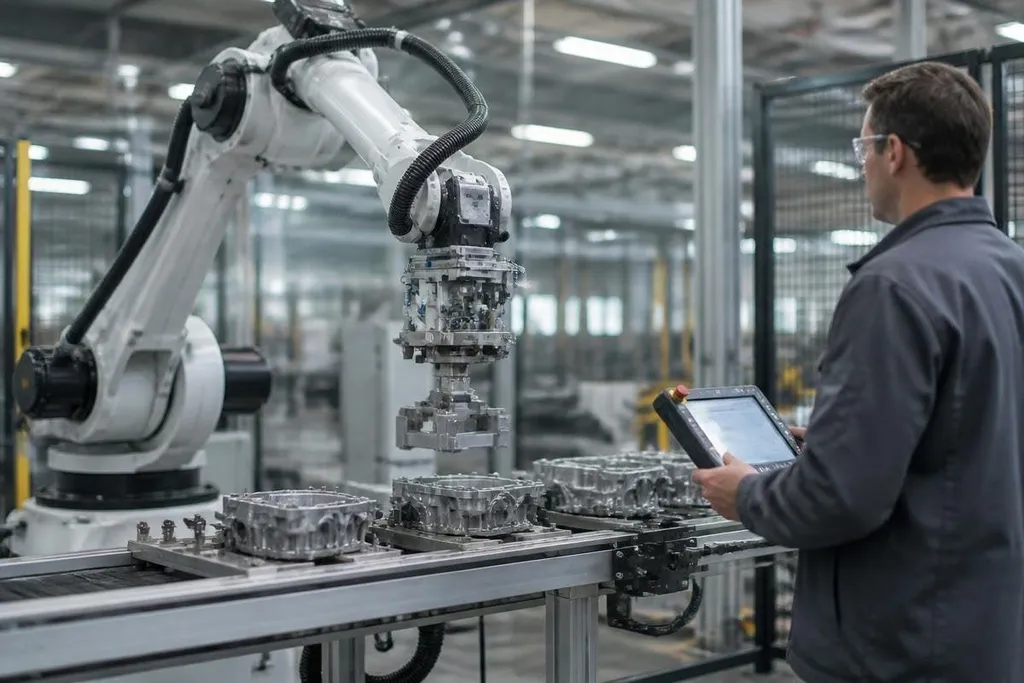
Industrial arms suit fixed work cells with known positions. Collaborative robots can share some work areas with people, but their speed depends on safety settings and risk checks. Mobile robots move material between stations, while vision systems help machines find and inspect parts.
The control system matters too. It may use force sensing to detect contact, machine vision to locate a part, or a software system that links the robot to production data. Those tools matter when the work changes during a shift, but they also add parts that need setup and service.
A factory trial matters only when the report names the robot, task, site, and date. Robot24.com can put those details beside the maker’s claim, so you can see whether the machine handled a full production run or a controlled test. The next section looks at what a polished demo leaves out.
What the demo leaves out
A factory robot must run beside people, tools, dust, vibration, and changing orders. A clean video may show the arm completing one task while leaving out the setup time, failed attempts, safety stops, and manual steps around it.
The unproven part deserves its own line in every buying review. Ask whether the maker has published data from a live plant, how many hours the robot ran, what stopped it, and who fixed the problem.
Ask for the test conditions too. A cycle-time number has little use without the part, payload, path, and safety limits behind it.
Price needs the same care. The robot arm may be only one part of the bill. The cell can also need a gripper, camera, fixture, safety scanner, controls, installation, training, and service. A low machine price can lead to a high project cost if the task needs custom work.
I'd avoid calling any supplier the leader until its factory results are public and comparable.
A buying check for factory managers
Use this list before you compare two systems:
- Name the task: write down the part, motion, handoff, and required output.
- Record the limits: note payload, reach, speed, accuracy, noise, floor space, and safety rules.
- Request test data: ask for run time, cycle conditions, stop counts, and the source of each number.
- Price the full cell: include tooling, software, guarding, installation, training, and service.
- Plan the changeover: check how long a new part takes to set up and who can do the work.
- Set a pass mark: decide the output, uptime, defect rate, and payback period before the trial starts.
These checks turn a broad market story into a plant decision. They also make it easier to compare a familiar industrial arm with a newer system built for flexible work.
The global race will matter to factories only when makers publish enough data to compare real tasks, full costs, and long shifts. Until then, the best robot is the one that meets your written pass mark without hiding the work around it.